Opinions on training for competition, such as sport Jujitsu or Mixed Martial Arts, versus training for real-world conflict fall over a wide spectrum. On one end is a crowd that advocates “If it won’t work in the cage, it won’t work anywhere,” and at the other extreme is an equally large group insisting “There are no rules on the street.” The two sides stand there snarling, each assured of its superiority. This is a shame, because both camps can benefit greatly from lessons learned on the other side.

If that picture seems ugly, we can take some comfort in the fact that most of us fall somewhere in the middle: competitors wondering how well their skills will translate to conflict outside the ring, and unarmed self-defense specialists wondering if their methods can stand up to a trained fighter. In order to bridge this gap and develop well-rounded warriors, we first need to understand the differences in the two arenas and the ways they have been approached.
Since there are several types of competition, I’ll primarily focus on differences between methods used in Mixed Martial Arts and reality-based training. While there is wide variance in how both are addressed by different coaches and trainers, I think the biggest differences can be summed up in the following three areas: odds, setting, and emotions. Bear these differences in mind and you’ll learn how to get the most from your training.
Odds
In an MMA match, great pains are taken to keep the two combatants on as level a playing field as possible. Weight classes, experience levels and gender separation are all used to get the best fights possible. Even the equipment of the two fighters is nearly identical. This is all in the promotion’s best interest: fans love a knockout, but they love it more ten seconds from the last bell than ten seconds after the first.
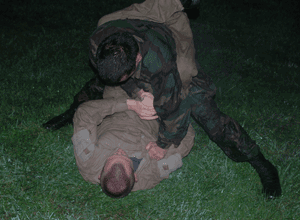
Since a fighter knows all else is designed to be equal, he builds the advantages that he can. Physical fitness becomes a way of life, almost an arms race between the combatants to be fitter and stronger than the other. Additionally, a fighter will train his technique every day, often year round. He knows what he can make work, and what to do next if it doesn’t work.
In real-world conflict, the odds are almost never even. If you find yourself on the receiving end of an unprovoked attack, it is often because your attacker perceives that you are at a disadvantage. They will be larger, stronger, better armed or greater in number as a rule, and sometimes a combination thereof.
Persons training for realistic unarmed self-defense will work on techniques that can address multiple opponents and also incorporate armed attackers. The scope of the potential threats is so broad that not all can be addressed, and techniques are often not practiced at full speed or full force due to increased risk of injury. It is also much easier to fall into the “what if” trap than in training for competition.
If faced with a single attacker, a competitive MMA fighter has a very high chance of surviving the encounter. He will often be physically more fit and mentally more prepared than his counterpart. But when a weapon is introduced or the number of attackers increases, the fighter’s chances of survival drop sharply, due to a tendency to engage when running is a better option. It’s not that an MMA fighter is miraculously fearless, but retreat is not an option in his training, so it may not occur to him when faced with a lethal threat. Also, ground-fighting techniques that work extremely well against a single attacker carry more risk against multiple threats.
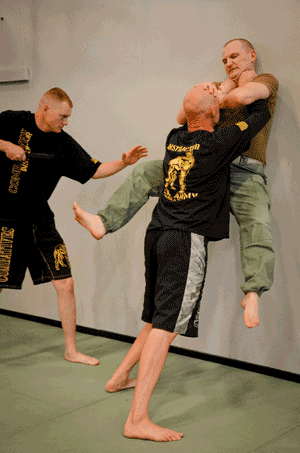
As currently taught by most, unarmed self-defense often produces a fighter less physically prepared for the conflict (unless s/he has taken physical fitness as a personal goal) and using techniques that have often not been practiced to the dogged extent of a competition fighter. However, because retreat is programmed into their training as a go-to option, and because their training includes the notion of an armed attacker, a fighter from a good reality-based training school may stand a much higher chance of surviving multiple attacker scenarios than an MMA fighter. It is not as much about proper technique as proper tactics.
Setting
When we hear the term “street fighting,” we usually imagine some back alley strewn with broken glass and dramatically swirling newspaper tumbleweeds. In reality, there is no setting in which violence cannot occur. The highly variable nature of real-world violence has to be acknowledged. The terrain, lighting, available escape routes, and presence of others (friend or foe) all dictate the tactics used in a particular incident.
In MMA competition, there is very little variance in the actual setting of the fight. The competition area may be 16 feet or 30, but it is always well-lit. It may be round, octagonal, hexagonal or square, but the flooring is always level and free of obstacles. The barriers may be chain-link steel or tightened hemp rope, but the combatants are always confined. There is no escape route, and the population of the world is three, only one of whom is attacking you.
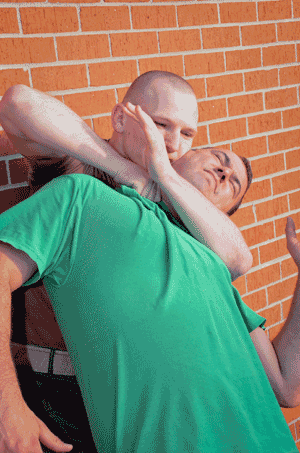
It may seem odd, then, that I find more fault with much of the reality-based community than I do MMA trainers on the issue of vertical surfaces. In an MMA gym, the first thing you notice is that almost every wall is either padded or shrouded in chain-link. MMA fighters constantly work off the wall: back against the wall, attacker against the wall, on the ground at the base of a wall. You are taught that the wall is your worst enemy and your best friend. And the world is full of walls: hallways, store fronts, vehicles, trees, and furniture all present vertical surfaces that are very likely to come into play in a violent attack. Yet I currently only see this addressed regularly in high-level military and law enforcement training outside of MMA. I hope to see that change.
One way in which reality-based training does have the upper hand with regard to setting is in the use of improvised weapons. While an MMA fighter sees a stool as an obstacle to avoid, the reality-based fighter sees a shield or cudgel. More is on the table (including the table itself) for the reality-based combatant because his training allows for it. Training to use improvised weapons when available prevents over-reliance on the empty hands.
Emotions
From the outside, it doesn’t seem like there is much at stake in a competition MMA bout. Often even the loser leaves the ring under his own power. Your life is not perceived as being at risk, and only occasionally are your limbs. But don’t assume that means the emotional and psychological factors of a bout are small. Fear, especially of performing poorly and disappointing peers and mentors in front of a massive crowd of strangers who may base a great deal of their opinion of you on the outcome, is enormous. These factors are magnified as your body keys up for the match -- this is a “fight or flight” scenario from which the flight option has been artificially severed.

I vomited a few minutes before my first bout, and I know more experienced fighters who always have. Having other fighters around you to tell you this kind of thing is normal goes a long way in establishing a better understanding of the body’s reaction to stress, not as an abstract concept but as personal experience. Even if a fighter doesn’t win, he gains valuable insight into his own body and mind. This is an area in which competition excels.
Real-world violence doesn’t creep along, shouting warnings ahead of it. It happens extremely fast, causing the sort of emotional spike that can result in panic. The adrenaline, accompanied by fear, causes focused vision and a dampening of the sense of hearing known as auditory exclusion. Fine motor skill is lost and, in extreme cases, the body may drop any unnecessary cargo, which is a polite way of saying you lose control of your bowels. All of this is normal, but that doesn’t make it less terrifying at the time. If not properly understood, the memory of these actions can be a source of unwarranted shame.

Fighters in the combat sports have always known and experienced these issues. Mental preparation and mindset are huge parts of competition fighting. The fact that fighters do not experience the extreme manifestations of stress experienced by victims of criminal violence may account for some of the misconceptions and guilt those victims later feel. It is important to remember that admonitions to “be a man” do nothing to override biology.
The industry of reality-based training, however, is making increasing headway in the areas of mindset, mental preparation, and understanding the body’s reaction to stress. Largely due to the publication of well-researched scholarly works such as On Combat by David Grossman, added to a foundation of earlier works like Jeff Cooper’s Principles of Personal Defense, the reality-based training community is addressing psychological and physiological factors of violence better than at any previous time in history.
Conclusions
There is a great deal that reality-based fighters can learn from competition fighters, and vice versa. While it is understandable for individuals to take pride in methods and techniques they have put in the time and effort to learn, we should never let that pride blind us to the advantages of other methodologies. In Part II, I look at ways MMA fighters can adapt their training to defend against violence outside the cage, and how reality-based fighters can bring the skill and intensity of sport fighting into their training.

Share tips, start a discussion or ask other students a question. If you have a question for an expert, please click here.
Already a member?
No Responses to “Pride and Glory, Life and Limb Part I: Differences Between Competition and Combat”