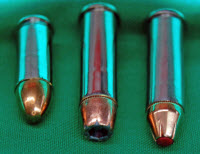
Left to right: full metal jacket round, traditional hollow point, and more modern personal-defense round with polymer tip.
www.personaldefensenetwork.comA handgun cartridge was designed to do one thing, but not what most people think. The term “knock-down” power is the most misleading term in personal defense. There is no handgun cartridge with the capability to “knock down” a man. I also submit to you that no handgun bullet in history was ever designed to knock a man down.
Throughout history, there have been two primary types of weapons: Impact weapons and cutting weapons.
Impact weapons are designed to hit the target with sufficient focused energy to destroy the target or stop the target from moving. A large-scale example is the MOAB, or Mother Of All Bombs. The MOAB uses explosive energy alone, with no shrapnel, to destroy targets.
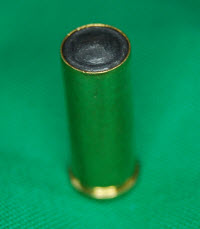
Wadcutter round used to cut smooth round holes in paper targets during competition shooting.
www.personaldefensenetwork.comCutting weapons are designed to do just that, cut. Pointed sticks, spears and swords evolved into firearms. Bullets are designed to cut the opponent, pierce organs and disrupt the central nervous system. The invention of gunpowder gave distance and range to the spear in the form of the bullet. While the technology of the delivery system changed, the target (the human body) remained the same.
There are two primary methods to stop or kill a mammal, and men are mammals: Disrupt the central nervous system and cause massive blood loss.
The first is the most difficult. The total disruption of the central nervous system by destroying the medulla oblongata will cause complete shutdown of the target. This requires placing a shot at the base of the brain that penetrates the skull and destroys the “apricot.” This is extremely difficult to do with a handgun cartridge. The brain bucket has been designed to protect that most important organ and it does a pretty good job.
This cartridge is specifically designed for short-barreled revolvers like my Smith & Wesson 340 PD.
www.personaldefensenetwork.comA man who is not quickly stopped is still a danger. Many men, “good guys” and “bad guys,” have been shot but continued returning fire and attacking. The FBI Miami Shootout is an example of men, good and bad, who were shot but continued to fight.
Ultimately the bullet has to penetrate and cut the target to cause central nervous system disruption or blood loss. Penetration is something that is rarely discussed in self-defense circles, but I believe it is a key element for proper cartridge design.
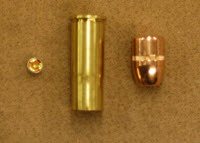
Basic components of a pistol cartridge are the bullet, case, powder, and primer.
www.personaldefensenetwork.comCartridge Design
A firearms cartridge consists of the bullet (projectile), case, powder, and primer. A good personal-defense cartridge must optimize all of these elements. Penetration is a crucial element in the cutting power of any handgun cartridge.
Bullet considerations include:
- Caliber or diameter of the bullet
- Bullet weight
- Bullet design
Many discussions have been had about the best caliber for self-defense handguns. I will summarize them by saying it is a personal decision based on your needs and abilities.
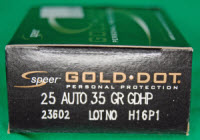
.25 auto round only has a 35-grain bullet and minimal velocity. I do not recommend this cartridge for personal defense.
www.personaldefensenetwork.comTom also touches on the fact that a bullet is a cutting weapon: “Calibers smaller than .38 Special/9mm do not penetrate enough to reach truly vital structures deep within the body. Once the threshold of adequate penetration is reached, bigger caliber bullets seem to offer two advantages:
More likely to break a bone than to glance off it;
Larger diameter wound track, bleeds more profusely/quickly. Which carries more water in the same amount of time, a garden hose or a fire hose?”
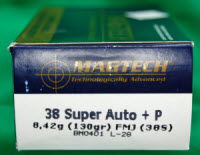
Be sure what you are buying. The .38 Super cartridge is for a semi-auto handgun, not the .38 revolver many people think of when they hear “.38.”
www.personaldefensenetwork.comBullet design is a key element. There are many choices for modern hollow-point self-defense ammunition. Some ammunition companies are very effective at advertising. I strongly suggest investigating the manufacturer and type of ammunition carried by law enforcement. LE agencies spend a great amount of time, effort and money to determine the best carry cartridge. The work they have done may be beneficial to you and save you time and money as well.
Having said that, how do you find out what ammunition law enforcement agencies are carrying? There is no central collection point of information. The easiest way is to ask your friendly neighborhood cop. Preface the conversation by letting the officer know you are a legally armed citizen or CCW permit holder. Tell him you are looking for a good personal defense round and ask if he has any suggestions. He may suggest what the PD carries or he may have other suggestions that might be better for you. Remember what I said about some ammunition manufacturers being very good at advertising.
Calling local training academies could get you some useful information as well. Just be sure to tell them why you’re asking. LEOs face many dangers and are always on guard for bad guys trying to collect intelligence information on equipment and tactics.
Search the Internet. Unfortunately, there are many unsecured law enforcement forums. A simple Google search of “law enforcement duty ammunition” can show discussions about this topic. Just be aware that the information on these forums may not be real or accurate, just like anything else in the cyber world. I don’t mind giving that suggestion because the bad guys already know it.
As with any product you buy, perform due diligence. Is the company a reputable manufacturer that has been in business for a long time? Check online for information about the product. Is this a solid and proven design or is it a new “miracle” ammunition?
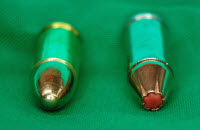
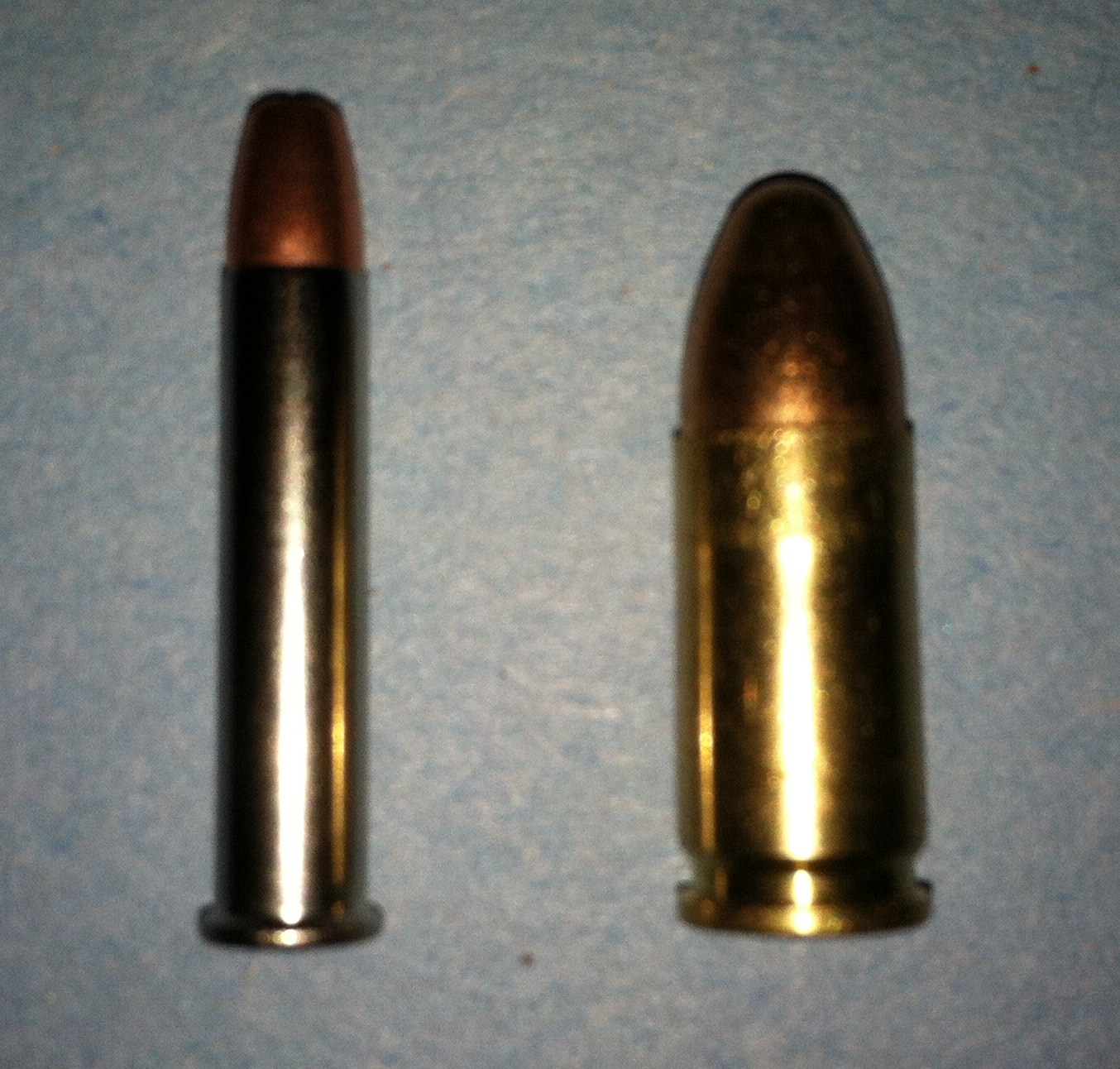
9mm full metal jacket round and new polymer tip hollow-point round also in 9mm.
www.personaldefensenetwork.comAs shooters, we are responsible for all rounds we send downrange, and many of these multiple-projectile and shot-shell cartridges cause an unacceptable spread in the pattern. I love shotguns for personal defense, but they were not designed to be used out of pistols with rifled barrels.
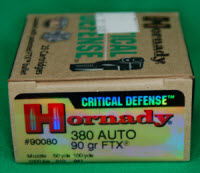
This 90-grain bullet in a .380 personal defense round leaves the muzzle at 1000 feet per second. Compare that to a 9mm or other calibers.
www.personaldefensenetwork.comPowder
The powder load directly impacts the velocity of the bullet. I believe that velocity is the key element not discussed in self-defense circles. For years we have heard that the 9mm is better than a .380, and yet the bullet is very similar in size and weight. The significant difference is the velocity of the bullet.
I strongly urge shooters to carry +P loads for any firearms that are rated for that cartridge. The +P is a cross between a standard cartridge load and a magnum load. It gives increased projectile velocity and better cutting power and penetration. Be sure to check that your firearm is rated for a +P load before you use it in that firearm.
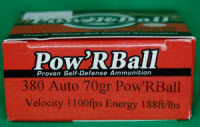
Another manufacturer makes a .380 with a slightly lighter bullet with increased velocity.
www.personaldefensenetwork.comThere is +P+ ammunition available. This ammunition is generally used for pistol-caliber carbines, specifically machine guns. I strongly recommend you do not use +P+ ammunition in any firearm unless you are certain that the firearm is rated specifically for +P+ ammunition. Be certain your firearm is rated for whatever ammunition you use.
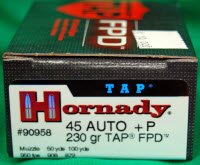
Here’s the big-daddy, the flying ashtray. This .45 leaves the barrel slowly but has a big 230-grain bullet. And this is a +P!
www.personaldefensenetwork.comHand Loading Ammunition
I do not recommend hand loading self-defense ammunition. There are many liability concerns should you have to use the ammunition in self-defense. Modern manufacturing techniques are so good that buying ammunition from a manufacturer is a much better choice.
The case and primer need to be good quality and properly sealed. Ammunition for self-defense is carried in all sorts of weather and conditions. The modern commercial techniques are proven.
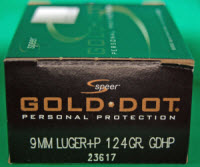
This 9mm round leaves the muzzle at 1220 feet per second and has a 124-grain bullet. The increased bullet weight and muzzle velocity make the 9mm more effective in personal defense than a .380 handgun.
www.personaldefensenetwork.comAmmunition Maintenance
Hopefully you are going to the range on a regular basis. Check your expensive carry ammunition as you load and unload at the range. The oils in your skin can cause corrosion over time. Look for damage to the cartridges. Check the bullet and ensure it is properly seated to the case. Watch for anything out of the ordinary and replace any damaged ammunition.
Ammunition is a perishable commodity. It will lose effectiveness over time with exposure to heat and cold, snow and rain, and human hands. Consider rotating your carry ammunition. I trade out my carry ammunition every year at my birthday. It’s an easy date to remember, and I shoot it to give myself exposure to the carry load and a little birthday present.
The firearm you spend so much money on to buy and train with is absolutely useless without effective ammunition. Spend a few dollars more and get the best ammunition to keep yourself and the people you love safe.

You actually stated this terrifically!
I have had a lot of trouble researching information on small business web design and seo, lucky I discovered this...very informative Do you participate in any social sites
Hello, you used to write magnificent, but the last few posts have been kinda boring… I miss your tremendous writings. Past few posts are just a little out of track! come on!
No shortcuts, no hot keys, inappropriate formatting in addition to the all in and around messy to work with screenwriters. Software refinement is most of the time done with a power team of travelers ranging with size totally from three returning to hundreds. There are assortment of methods involving drug testing too.
Good way of explaining, and nice piece of writing to get facts regarding my presentation focus, which i am going to deliver in institution of higher education.
Secrets for the Best Personal Defense Cartridge - Personal Defense Network Appreciate the recommendation. Let me try it out.
The information is really appealing. Thanks with regard to providing these awesome knowledge. When the first time I visit this website I was curious to know what different this site can offer to me but now I can say that this is worth spending time on here.
Every weekend i used to go to see this website, as i want enjoyment, since this this web site conations actually pleasant funny material too.
Pretty component of content. I simply stumbled upon your blog and in accession capital to claim that I get actually loved account your weblog posts. Any way I'll be subscribing for your feeds or even I achievement you get admission to constantly quickly.
Awesome! Its really awesome article, I have got much clear idea on the topic of from this article.