One thing that distinguishes snubs and revolvers from autoloaders is that a variety of stocks differing widely in size, shape, and material can be fit to them. This can be either an advantage or a disadvantage. If they fit you well, they can really enhance your shooting. If they fit you poorly, you aren’t going to shoot to your full potential. To distinguish between the physical act of holding the gun—which most of us refer to as grip—and the wood, rubber, or plastic pieces encasing the frame of the weapon, I will refer to the latter as stocks, although they’re also commonly called grips.
There are three important functional components of snub stocks.
- 1. Trigger reach
- 2. Support hand on the gun
- 3. Surface friction
Each has an effect on how well you can shoot your revolver. Aesthetic components are also important to some people, but aesthetics should be kept in their place.
Trigger Reach
Trigger reach is the distance the finger has to travel from the backstrap of the gun or stocks to the face of the trigger. It is the component that controls how well we can smoothly work the trigger straight to the rear. This isn’t necessarily a linear number that can be measured with a ruler, although it can be determined with a tape measure. It’s not linear because the thickness of the stocks can have an effect on it. This is an important component because it determines where on the finger the trigger makes contact when the snub is acquired quickly. What we ideally want is for the first joint of the finger to make contact with the trigger, either on the face or the edge of the face on the firing hand side. This placement allows us to move the trigger smoothly back in a straight line. If too much of the finger enters the trigger guard, there is a tendency to push the revolver to the opposite side. If not enough of the finger enters the trigger guard, the finger has a hard time developing enough leverage to move the trigger back smoothly, and the result is a jerk that is difficult to control.
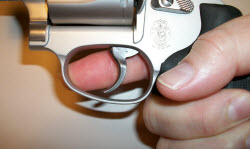
Here's an example of proper trigger reach.
www.personaldefensenetwork.com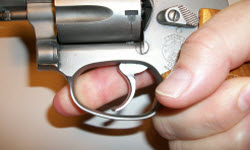
Too much trigger reach.
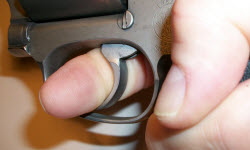
Too much finger in the trigger guard.
www.personaldefensenetwork.com
Index marks comparing the two.
www.personaldefensenetwork.comSupport Hand on the Gun
The amount of support hand on the gun is the component that determines how quickly we can fire multiple shots with our snub. We keep the gun from squirming in our hand when firing by creating a frictional lock between the gun and our hands. With a small revolver, two subcomponents contribute to this. First, the amount of your hands that physically makes contact with the gun, and second, a certain amount of camming action by the fleshy part of the support hand below the thumb against the fingertips of the firing hand. Both of these sub-components are controlled by the distance between the fingertips of the firing hand and the fleshy part of the hand below the firing thumb.
Larger Grip
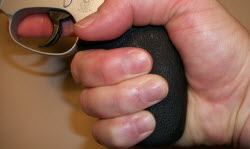
Here's a stock I can control well.
www.personaldefensenetwork.com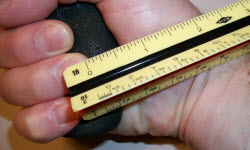
Let's put a number on it. Over ¾" open space.
www.personaldefensenetwork.comSmaller Grip
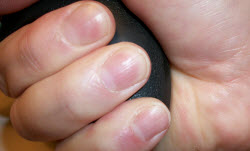
Here's a smaller stock.
www.personaldefensenetwork.com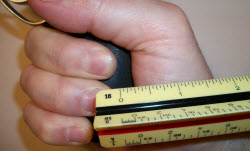
This open space measures a little over ¼”.
www.personaldefensenetwork.com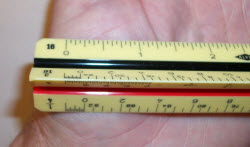
Base of left thumb. 1" wide.
www.personaldefensenetwork.comTo achieve a frictional lock on the stocks of the gun, the base of the support thumb has to enter the opening between the firing thumb and fingertips. If the thumb doesn’t go in the opening, instead of the support hand having a frictional lock on the stocks, what you have to lock your support hand in place is whatever friction you can create against the fingernails of the firing hand. That’s not much. True, some of that thumb will squeeze into a smaller opening, but at some point it becomes a square peg/round hole situation. That is what’s happening when you see people shooting a snub and they have to regrip the gun after every shot. Even with +P .38s, if the stocks fit you, you shouldn’t need to regrip after every shot.
In some cases, you have to make compromises between the optimal size of the stocks for shooting and the optimal size for concealment. In many cases, the proper size stocks will be less than optimal for pocket or ankle carry. In most cases, the tradeoff is better achieved by using a shorter stock than by going to a shorter trigger reach. The little finger doesn’t contribute as much to a proper grip as making enough contact with the support hand does.
Surface Material Friction
To create a frictional lock on the gun to control it, you need, well, friction. Unless you walk around with rosin on your hands all day, it’s hard to create friction on smooth-surfaced stocks. Nice, smooth wood stocks look pretty. However, it’s really hard to shoot the gun fast with stocks that let the gun slip around in your hands like a live frog.
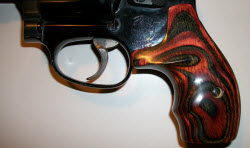
Smooth stocks.
www.personaldefensenetwork.comFinding stocks that fit your hands takes a bit of time and effort. There’s also a good probability that what fits someone else will not fit you. In the end, shooting a five-shot group with a timer will probably tell you what works best for you.
For me, Crimson Trace Lasergrips work well on my J frames. I have them on a S&W Model 60, a S&W Airweight Bodyguard, and a Taurus 585 (?), and they all are comfortable and fit my hand well.
I can use wood on a K or L frame but the J frames need Hogue Tamers and for easier hiding the Hogue Bantam. On the boot grips after each round, I do have to re-grip but for the Tamers I don't. It's a little harder to hide the Tamers so dress dictates which I carry.
The main advantage of smooth stocks on a j-frame size revolver comes when you carry it in your front pocket. With smooth stocks, it is easier to get your hand on either side of the gun, and withdraw it smoothly. I have tried this with many of the sticky rubber grips, and it just cases too much fumbling. That having been said, some checkering on the wood is always good, and doesn't have to be deep enough to effect draw.