What's next?
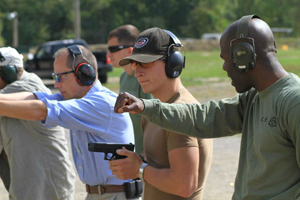
Many people who buy a handgun fall into one or more categories: recreation, competition, or self-defense. Normally I find those who buy a gun for recreation or competition understand the budget required to manage their new hobby. But people who buy a handgun for self-defense often aren't knowledgeable about the associated expenses of training, practice and equipment.
There are plenty of articles and resources dedicated to helping self-defense shooters understand why they should train, but not many on how to go about budgeting for training. If you look at those who decide to take unarmed self-defense training, they have most likely taken the following steps: researched training providers, viewed the costs, decided their commitment level, visited a number of providers, and committed to training. Most self-defense schools advocate that students take ongoing training in order to further develop their self-defense skills.
So let's say you already have a defensive handgun that came with two magazines. You have no holster, ammunition, or training. This scenario applies to most people new to defensive shooting. Like unarmed self-defense, defensive shooting requires proper training and practice. Defensive shooting training also requires equipment such as a holster and both defensive and training ammunition. Although it may seem like a lot, I am going to assume you have a budget of only $1000.
Budgeting $1000 may seem daunting at first, but if you research the cost of unarmed training over the period of a year, you might actually find defensive shooting cheaper than or competitive with the costs for most unarmed self-defense programs. For example, you find a provider that teaches an unarmed self-defense program and they charge $150 per month. You will also have to factor in protective gear (which may include gloves, headgear, shin guards, and mouthpiece), uniforms, and miscellaneous gear such as training guns or knives.
To make your budget effective, you must prioritize your needs and wants. The basic needs of a defensive shooter are: handgun, defensive handgun training course, magazines, training and defensive ammunition, holster, and ear and eye protection. You may also want a cleaning kit, flashlight, and range bag.
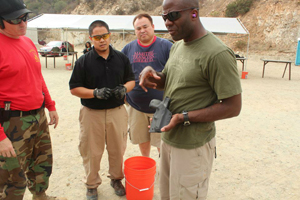
Defensive Handgun Training Course
Let's start with the most important consideration -- choosing a defensive handgun training course. There are many options in regard to such courses, but it’s important to make sure the course fits your requirements. Questions to ask yourself before you invest in a course should be:
- Does the course fit my lifestyle?
- Does the course information apply to my environment?
- Will I be learning skills I can apply when I leave the course?
- Is the course taught by a competent instructor who understands my needs?
- Is the course material based on my context? (e.g., home defense, defense in public places)
Not all defensive handgun courses are created equal. The key components should include basic operation of the firearm, firearm safety, how to manipulate the firearm, defensive shooting skill development, reloading procedures, malfunction clearing, how to communicate with emergency services, and what steps you should take in the aftermath of a defensive shooting incident. One aspect of defensive shooting that is not included in some courses is how the brain reacts to violence and fear during a confrontation. More important than the shooting is knowing how to get to the shooting part when you are under extreme stress.
Shooting is a perishable skill. If you don't practice regularly, your shooting skill will diminish. Your ability to practice or develop a sustainable training schedule will be based on your motivation, budget, and resources. I recommend my students get on the range and practice a minimum of once every three to four months. Your training provider can help you create a cost-effective training schedule.
Defensive shooting course costs range anywhere from $50 to $600. The cost of the training is mostly determined by the length of the course, which can vary from two hours to four days, depending on the course material advertised. Types of courses are basic pistol, tactical pistol, concealed carry, home defense, advanced pistol, and handgun skills. For a beginner in defensive firearms training, you may want to budget about $200 to $400 for a one- or two-day course.
A one-day course is like the first day you learn to drive. It can almost be overwhelming. A two-day course may require more money, but allows you to learn on day one and practice on day two under the watchful eye of your instructor. I recommend starting with a two-day course.
Holster
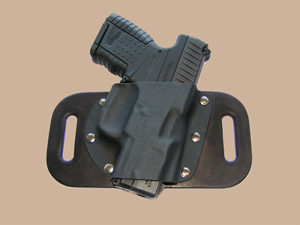
Your choice of holster depends on how you decide to carry your firearm. If you are using your defensive firearm primarily for home defense, a holster may not be a priority. Learning to present your firearm from the holster is one of the most complicated skills and deserves some attention even if you don’t need one. However, if you are legally able to carry a concealed weapon in public, it is imperative that you choose the right holster for you.
Holsters come in a variety of styles, but most are relatively cost effective, around $40 to $100. The most common holsters are inside the waistband and outside the waistband. Holster material is usually leather or kydex. Some are made with both.
Holster choice comes down to two things: function and comfort. The holster is designed to retain your firearm when not in use. Some holsters on the market feature double or triple retention. Added retention devices such as buttons or levers are designed to keep the firearm from being deployed unnecessarily. I recommend you choose a holster that is most efficient for you, meaning you can deploy it quickly without getting the gun jammed when you need it most.
Training and Defensive Ammunition
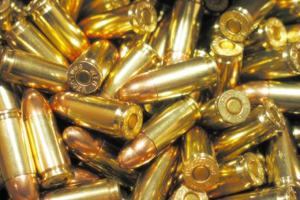
Now that we’re about $240 to $500 into your budget, let's talk about ammunition. Ammunition is the one category of equipment that can take a huge chunk of your budget. An average one-day training course can require anywhere from 200 to 500 rounds of ammunition. Two-day courses can range from 500 to 1200 rounds of ammunition.
Getting into the details of the different manufacturers of training ammunition is beyond the scope of this article, but let's cover the basics. Two types of ammunition are on the market. Factory ammunition is made by a manufacturer, while reloaded ammunition has been recycled. Although reloads may be cheaper, factory ammunition can be more cost effective in the long run. Reloaded ammunition tends to cause more malfunctions with your firearm than factory ammunition.
Ammunition also comes in various calibers, and you need to buy the proper ammunition for your firearm. A key point here is that the lower the caliber, the cheaper the ammunition. For example, 9mm ammunition is cheaper than .45. The most cost-effective ammunition is 9mm because its relatively low price allows you to train consistently without diminishing your ability to defend yourself.
Ammunition for a training course can cost up to $200 for 500 rounds. You may also want to budget your ammunition cost for a longer term. It is usually cheaper to purchase ammunition in bulk rather than by 50-round boxes.
Magazines
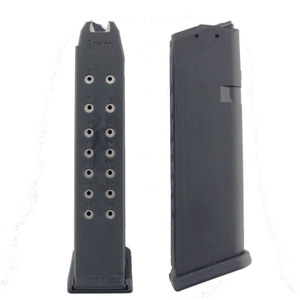
When you start your training regimen, you’ll find it beneficial to have extra magazines. Just like anything else, magazines are man-made and they break. In outdoor courses, your magazine may get dirty, so having extra magazines can help keep you focused on training, not maintenance. A quality magazine could cost you about $40, depending on your type of firearm. Most training providers recommend you have a minimum of three magazines. Get five just to be safe.
Conclusion
We started with a defensive handgun, two magazines, no holster, no ammunition, no training, and a $1000 budget. We discussed probable costs along the lines of:
- Training: $200 - $500
- Holster: $40 - $100
- Ammunition: $200 - $500
- Magazines: $120 (three plus the two you already have)
- Safety equipment: $100 (quality eye and ear protection)
On the low end, you will be spending close to $700. The maximum you will spend based on the estimated costs is $1320. I am confident you can find quality training and equipment for around $800.
The numbers I’ve used are approximate and meant to give you an idea of what type of monetary investment you will need to start your defensive firearms training regimen. There are many opinions throughout the industry on what you should or shouldn't do. At the end of the day, it’s your choice. Hopefully this article helped get your mental wheels turning and will inspire you to take action. Just because you own a firearm for self-defense doesn't mean you are prepared to use it for self-defense. Get the proper equipment and training to truly prepare yourself for the worst.
Thank you for every other informative blog. Where else could I am getting that kind of information written in such an ideal method? I have a project that I'm simply now running on, and I've been on the glance out for such information.
First off I want to say excellent blog! I had a quick question that I'd like to ask if you don't mind. I was interested to know how you center yourself and clear your thoughts before writing. I've had a tough time clearing my mind in getting my ideas out. I do take pleasure in writing but it just seems like the first 10 to 15 minutes are generally wasted simply just trying to figure out how to begin. Any recommendations or hints? Thank you!
Good article. Just like every hobby, you buy the thing, then you need the thing to go with the thing. For budget mindedness, online ammo deals can save a lot of money. Bulk buys are better but not always feasible on a budget. Get chummy with your local Walmart Sporting Goods person. I've been amazed at the stuff they hold back from the shelves or the "special buys" that don't get advertised. Also, on a budget, don't rule out the "budget" guns. When family ask me about guns I just ask them, what do you want it to do? Function over Form, Price vs. Performance. Sure, a HI-Point semi-auto or Taurus Revolver may not be fancy, but they put the lead downrange just like a Glock or S&W. My last thought on this is when thinking about holsters, buy used whenever you can, at least, until you know what works best for you. It takes lots of trial and error to figure that out. And in the end, what ever didn't work for you, you can usually sell for at, or near, the price you paid for it. Crossbreed holsters are amazing, but you don't need to spend two hundred and twenty dollars for 4 different models to figure out what works best. Pick them up used for up to half off. Plus, I find, usually the holsters haven't even been used enough to really break them in. So you get them in like new condition for a fraction of the cost. Just my two cents.
how do you feel about full size handgun to compact cc
totallyagree
What is your opinion of the CZ 75D Compact PCR pistol? Thanks James