Common Carbine Malfunctions and Refunction Procedures
I am going to reference each malfunction via a brief description of the malfunction. Labeling a malfunction as Type 1, Type 2, Type 3, etc in my opinion does nothing to aid the operator in determining what is wrong with the cycle of operation of the firearm. Malfunctions are broken into two categories: simple malfunctions as covered here, and complex malfunctions, which will be covered in part 3 of this series.
- Simple Carbine Malfunctions
- Failure to Fire
- Shallow Failure to Eject
- Complex Malfunctions
- Deep Failure to Eject
- Failure to Extract
- Double Feed
- Triple Feed
- Failure to Unlock
Simple Carbine Malfunction Remediation
Immediate Action Drill (IAD):
Tap magazine aggressively (finger out of trigger guard).
Turn carbine outboard so ejection port is down.
Rack charging handle to rear and release. Do not ride charging handle forward.
Reassess target and environment.
Immediate action is used as a primary refunction procedure for all simple malfunctions. If the operator feels the trigger click, the hammer has dropped, which indicates that the bolt was able to fully cycle. The operator is experiencing either a Failure to Fire or a Shallow Failure to Eject. Be aware that performing immediate action on a double- or triple-feed malfunction will increase the severity of that malfunction and add to remediation time. Immediate action should not be utilized as a “non-diagnostic” go-to procedure. Follow the recommended guidelines and you will decrease the chances of this eventuality. CLICK means TAP, MUSH means RIP.
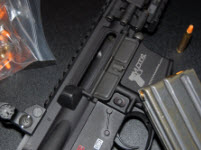
Failure to Fire:
the failure to fire is in most instances an operator-induced error. Causes of this malfunction include failure to properly seat the magazine, bad ammo, dirty bolt face or a damaged/broken firing pin. The most common is the failure to properly seat the magazine during administrative or combative loading. The operator will feel a click when attempting to fire and follow our Refunction Mantra: CLICK means TAP.
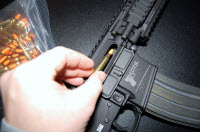
Setting up the Failure to Fire:
At Home
- Carbine, dummy rounds and a magazine.
- Verify you are using only dummy rounds!
- Insert magazine and drop bolt, chambering dummy round.
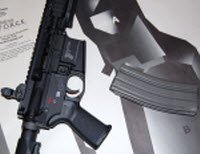
On the Range
- Carbine, live rounds and a magazine.
- Drop the bolt.
- Insert magazine with live rounds.
- Have a magazine loaded with an empty chamber.
- Press check to verify.
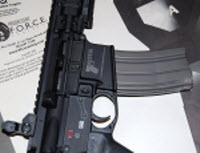
Failure to Fire – CLICK means TAP (IAD)
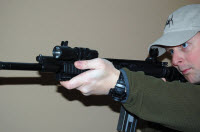
Operator attempts to fire and experiences a failure to fire, feeling a click. Immediate action drill is initiated.
www.personaldefensenetwork.com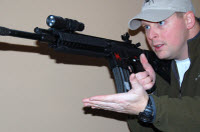 Carbine is rolled outboard and magazine is TAPPED aggressively.
*Finger out of trigger guard
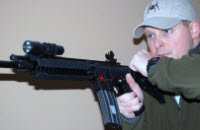 Charging handle release is depressed and handle is RACKED aggressively to the rear, ejecting the bad round. Handle is RELEASED, stripping a new round from the magazine and chambering the round.
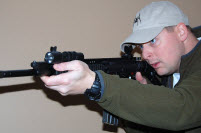 Sights are reacquired and target(s)/environment are REASSESSED.
Failure to Eject (stovepipe):
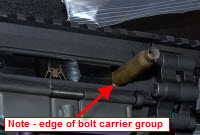
With the failure to eject, the bolt has reciprocated and in the process caught the previously spent casing as it was being ejected. Two specific types of failure to eject have been identified, the shallow and the deep. With a shallow failure to eject, the spent casing is caught between the edge of the bolt carrier group and the front vertical edge of the ejection port. Either failure to eject can be caused by blocking the ejection port (operator error or possibly crowding cover), dirty weapon, weak or broken ejector, or weak extractor spring. The operator will feel a click when attempting to fire and follow our Refunction Mantra: CLICK means TAP.
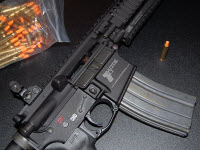
Setting up the Shallow Failure to Eject:
- At Home
- Carbine, spent casing, dummy rounds in magazine.
- Verify you are using only dummy rounds!
- With the bolt forward, insert a magazine loaded with dummy rounds.
- Pull charging handle back far enough to place spent casing into ejection port between edge of bolt carrier assembly and front vertical edge of ejection port.
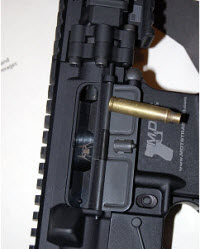
On the Range
- Carbine, piece of spent brass and a magazine with live rounds.
- Insert the magazine.
- Pull charging handle back far enough to place spent casing into ejection port between edge of bolt carrier group and front vertical edge of ejection port.
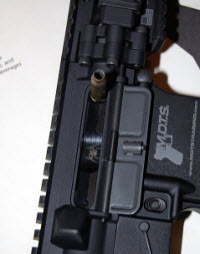
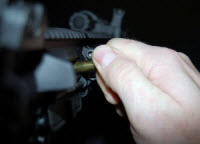
THIS METHOD IS NOT RECOMMENDED. DO NOT BREAK FINAL FIRING GRIP
www.personaldefensenetwork.comWhy can’t I just wipe it off or pull the piece of brass out?
If you are firing the weapon system, your first indicator of this malfunction will be your pulling the trigger and feeling a click. If this is the case, then the hammer has fallen and the firearm will not go on safe.
If there is enough brass available for you to wipe off or pull out, when you do so, the bolt may drop forward onto a live round. But you still need to reciprocate the bolt in order to cock the hammer, enabling the firearm to discharge. This reciprocation may possibly extract and eject the round that was in the chamber and strip and feed a new round from the magazine. Essentially, you have conducted a TAP, RACK.
This is a training deficiency associated with drilling vs. fighting or actually attempting to fire the carbine and then diagnose the problem. Training with dummy rounds at home in a safe environment is better than not training, but be aware that a critical component of the diagnostic process with this weapon system is attempting to fire live rounds.
Running a drill where the malfunction is already set up and can be visualized is far different than actually firing the carbine and experiencing the malfunction in-fight. For a left-handed carbine operator, visualizing the stovepipe is not a problem. But for a right-handed operator, with the ejection port on the opposite side of the rifle, distinguishing the stovepipe from the failure to fire is impossible. The time spent rolling the carbine inboard to attain visual reference is better spent following a fast and efficient immediate action drill.
CLICK means TAP, RACK and REASSESS.
Shallow Failure to Eject – CLICK means TAP (IAD)
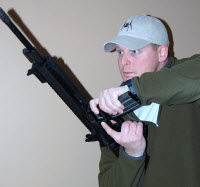 Operator has attempted to fire and experiences a shallow failure to eject, feeling a click. In this sequence, the carbine is brought into the high control position to better facilitate any rounds or debris falling out. Immediate action drill is initiated.
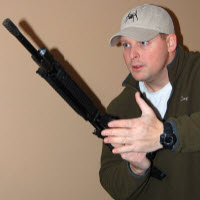 Carbine is rolled outboard into high control and magazine is TAPPED aggressively.
*Finger out of trigger guard
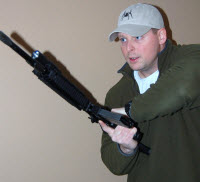 Charging handle release is depressed and handle is RACKED aggressively to the rear, ejecting the bad round and clearing the ejection port. Handle is RELEASED, stripping a new round from the magazine and chambering the round.
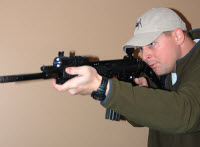 Sights are reacquired and target(s)/environment are REASSESSED.
In part 3, I’ll discuss the five types of complex carbine malfunctions and the refunction procedures for each.
Share tips, start a discussion or ask other students a question. If you have a question for an expert, please click here.
Already a member?
4 Responses to “Carbine Malfunctions, Diagnosis and Remediation, Part 2”

Sign up for our free newsletter today
Get the latest personal defense videos, tips and techniques delivered right to your inbox.
That is a really good tip particularly to those fresh to the blogosphere. Short but very accurate info… Appreciate your sharing this one. A must read post!
I don't understand the fix for the stovepipe malfunction. I thought that another round would be partially in the chamber when you have a stovepipe. So if you pull back the charging handle to clear the stovepipe, would the gun load another round into the chamber, creating a double-feed malfuction?
You will also be recruiting fantasy creatures clash of clans hack like dragons, barbarians, war wizards and many more. Never leave gaps in the walls or use buildings as part of the game. You just have to enter the number of individuals playing farmville has increased with a great deal.
w) There's an music of the overall guide book for you to upload it for your mp3 player you should following it vehicle, when you exercise, while you go walking your canine, on the practice, on the coach -- essentially wherever you go. Oahu is the genuine-existence, action-by-step complement which may enable you to get from a impulsiveness in winning your ex back or maintaining them from causing. A lot of folks obtain self applied-assist textbooks, get all interested in reading them, but never ever as well as go about doing exactly what the writer suggests. The ebook may even coach you exactly what to do on that initial go as far back with your ex - appreciate.