During a recent episode of The Best Defense TV show, my co-host and I demonstrated the use of a weapon strike against an opponent. I thought viewers might wonder why we would promote such a non-standard technique when simply shooting the person (if warranted) was possible.
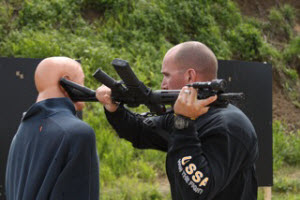
The main thing to keep in mind is that your gun should never be used as a striking object unless you believe lethal force is legal and justified. If your gun is in your hand, and the person you are dealing with is still combative, it might be reasonable to assume (depending on the facts and circumstances) that if they continue to fight and get their hands on your gun, you could lose it and possibly be killed with it. For this reason, articulating lethal force in most cases should be relatively simple.
Reasons
In every class I teach, I focus on the “whys” behind what I am teaching. This is critical for students to fully understand any technique. Why would we use a weapon strike at all against someone if lethal force is justified? Why not just shoot them? The simple answer is that you probably can’t due to the dynamics of the situation. Maybe shooting and fighting have integrated to the point where you’re not 100% positive what is in front of your muzzle, e.g., your own body parts!
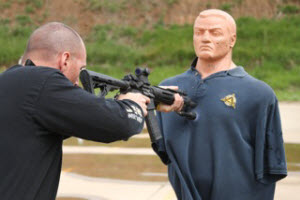

Another problematic scenario is if you are with other people, such as your family or team members, when a fight occurs. What if one of your family members moves into the line of fire? I often have my wife and two kids with me. If we were violently attacked and I got a gun into the fight, one of the children may move into the line of fire during the chaos. If I am not 100% sure where my bullet will go, I will not pull the trigger. If I’m in a position where I can’t shoot, yet still have a gun in my hand, I have the choice of fighting with one hand and trying to protect the gun with the other, or possibly using the gun as a striking object. In more than one situation, I would pick the latter in an attempt to gain distance and/or have some sort of effect on the threat.
Those armed with a rifle may face the same situation, and might even find themselves more likely to use a firearm strike. I know of more than one SWAT officer who has used a muzzle bump into someone’s chest or face to convince him that reaching for his rifle muzzle might be a bad idea. A rifle offers a bigger need (and possibly reduced risk of an accidental shot) for the use of a weapon strike due to its length. It simply may not be an option to protect the rifle and strike the person with the other hand. Remember, if the bad guy is reaching for the muzzle, then in most circumstances this situation could warrant deadly force.
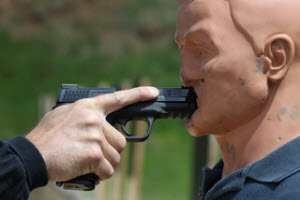
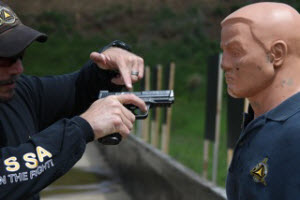
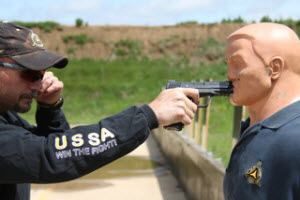
Jab Strike
Linear strike with the lead or rear hand, commonly known as a jab or cross.
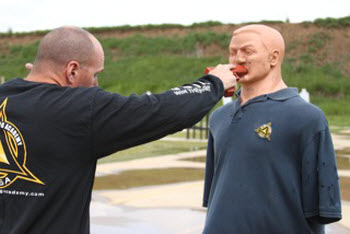
Hammer Strike
The hammer fist strike is a downward blow with a closed fist.
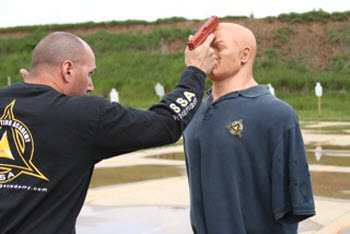
Hook Strike
The hook is a looping strike around the side of the head.
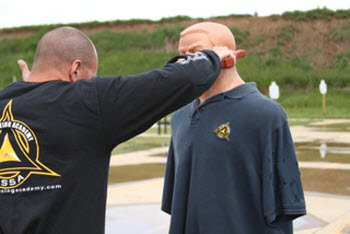
Safety note: This is a high-risk test. If you have not practiced weapon strikes, please do not repeat it.
Results
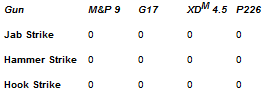
The number under each gun is the number of times it failed to fire after the strike. To be as realistic as possible, each strike was thrown with as much power as I had.
As you can see, the strikes did not cause any of the weapons to malfunction. The only exception was when I tried to strike with the finger in the trigger guard while trying to shoot. The gun did not go off, so I count this as a malfunction. In that case I simply pulled the gun away from the strike dummy and the slide went right back into battery, allowing me to shoot. In a rare situation where the gun malfunctions completely, a simple “tap, rack” should clear and make it ready to fire. But as you can see from my results, all weapons fired flawlessly, without a single malfunction caused by the strikes.
Conclusions
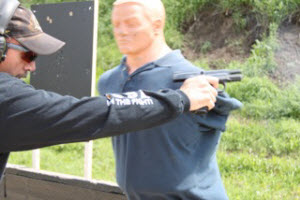
In closing, weapon strikes are effective, simple, and great potential tools if needed in a close-quarters fight. Learning them is not difficult, and I recommend training them safely using non-firing red guns, S.I.R.T. pistols, or Airsoft before trying them during live-fire drills. Remember that striking someone with a weapon involves a high level of force, so make sure you have justification before doing it!

Good info. I have a red training gun I have a red plastic training gun I use for hitting practice on my heavy bag. Good. good ariticle!
[…] In this article, Mike Seeklander tried a variety of different pistol strikes against a “BOB” dummy and then attempted to fire rounds from the handgun he had used for the strikes. None of the strikes he used either broke the guns or caused them to malfunction. […]