Worlds Collide: Shooting on the Move
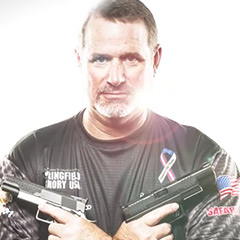
Rob LeathamThe hows and whys of effective shooting on the move are examined in the latest handgun training session with defensive shooter Rob Pincus of PDN and competition shooter Rob Leatham of Team Springfield.
Leatham’s Take
In competition, the two elements that determine a score are speed and accuracy. Targets are often shot on the move to save time. A competitor doesn’t shoot on the move to gain accuracy, because it doesn’t do that. If Rob has to shoot two targets that are not next to each other, he moves to get closer to each one. The sequence he advocates is: move -- draw -- shoot first target -- move to target two -- shoot.
The keys to accurate shooting on the move are good shoulder position, good arm extension, put the sights on the target, and pull the trigger without moving. Pincus replies that this sounds like standing and shooting, and Leatham agrees. The type of footwork employed is unimportant -- just don’t bob while moving during any shooting drills.
Why move while shooting in a competition? Because you can see where the targets are and moving gets you closer to them.
Coaching
Leatham coaches Pincus to take two shots each at the two targets while moving. Leatham advises him to stabilize the gun -- make the gun stop moving before his body stops. The result? Four solid hits.
Tactical Movement
Shooting on the move in a defensive situation is compelled by the specifics of each situation, for example needing to reach a family member. The mechanics are the same as competition shooters use: move -- draw -- shoot. Use the downtime of the draw to gain ground.
The two Robs conclude that the mechanics of shooting on the move for competition and defensive shooters are very similar, though competition shooters move to save time, while defensive shooters move to gain position.
Share tips, start a discussion or ask other students a question. If you have a question for an expert, please click here.
Already a member?
2 Responses to “Worlds Collide: Shooting on the Move”
Quite often in competition, Rob you can shoot targets on the move to save time. Now you would never do it to gain accuracy because it doesn't do that. So the only other element, there's only speed and accuracy when you're talking about the score. So at that point you would say, "well can I shoot that target on the move to avoid shooting at stationary?" But then I'll travel a certain distance between. Now before we get into the, to the context of tactical fight, there's some things you got to know.
If I'm going to shoot these two targets, this target here. If I had, if I was standing in this position and say I had the end up over there, somewhere. Because rules. Because there's a target I have to shoot from over there. Okay.
All right. And I know it's there because during my 5 minute walkthrough, I plotted where all the targets were. Got it. So the way I make people do it is, I want you to the very first thing to do is start moving. So you start moving draw.
So right now, if I had stood there and shot I would still be right there. And I would only be able to shoot slightly quicker. The trick to shooting on the move is really, really simple. You ready? Ready Good shoulder position, good arm extension.
But the sight's on the target pull the trigger without moving. It sounds like standing and shooting. It's exactly the same thing. We all make too much of it. We all, a lot of people try to come up with stepping positions.
I don't really care what you do Right? When I do it, I try not to Bob. That's it. All right Now, from the competition standpoint what that means is I've gotten myself one second further down the line. So the skill is probably very very similar regardless of what the context is But there's that ever present idea of, you know that you need to be over there and that's compelling the movement.
The movement as a priority. The movement That doesn't really exist. The movement is not based on my desire to leave the position Right. Go somewhere. It's because I have more targets to shoot over there because would you ever argue that, that speed of movement, which, which, you know, you're not sprinting that speed of movement makes you dramatically safer?
No. So you just stopped shooting. No no no its the... you just stop and shoot. It'd be over before I can move that far.
That's what I'm talking about If I was going to shoot these two dudes Rob, Right, you yeah. That's what I'm talking about. And that's what I think a [indistinct] is but the combination of needing to move and needing to shoot and balancing it out, Changes the whole, whole thing. All right, coach me. Okay.
So if you were, if I was having you do this all I care is that you start moving before because I don't want you engaging the first targets, target stationary. Got it. Alright. So I'm actually gaining some movement gaining some distance while I'm presenting. Right because the draw in the comp and in the competition worlds, I'm not going to stand there and draw and then move.
Sure Because I got to draw. I got to draw anyway. Right Because that clock, she's a ticking, Rob. Oh, I'm sure she is. All right.
She is. So when I say go, I'm going to say. "Standby. Ready. Go." You're going to draw or you're going to move.
Draw, shoot each target twice as you move across. Got it. Ready? Ready Standby. Ready?
Ready Go. Your movements. Perfect. I expect nothing less. I mean, I knew you were going to shoot well, I knew you can move well, the only thing I'm looking at is if we start looking at the target.
Look at that. Well that one's okay because that one is a C. But that one over there is in the D zone. So well that's, well pelvic shot is a great shot on a human. Well, I don't like that.
That's not an accurate. That's close to a miss so let's do it again. All right. So only thing I'm going to ask you to do is remember that bit before we were talking about making sure the gun stops moving. Yeah.
Yeah. Yeah. So you've got to make the gun stop moving without you stop moving. Got it. Hardest part.
Got it. Here we go. Standby. Ready? Fire.
Stabilize the gun. Perfect. So you took a fraction of a second longer which is probably in the 5 hundreds to a 10th of a second. Right. And created two A zone hits.
You're going to trade a D for a couple of tenths of a second every time Everytime. But so, and then in, in, you know, tactical world, right. I'm thinking this, even if I know if I'm compelled to to get out of the room, right. If I'm compelled my daughter's over there. Right.
And I want to get to that next room cause that's where my daughter is. I'd really go back, give me the go and I'll show you what we would do. Okay. You're ready. And then you tell me.
Standby. Ready? Ready. Go. And then, so we've got our situation where we we move on the draw a plan to shoot.
Right. Then move after we're done shooting. So, so what happens there is you're using the downtime of the draw Yes. To gain some ground. Right?
It's exactly the same thing. Reason I'm doing it. I'm doing. You're just, you're You're doing it to gain position. I'm doing it to save time.
Got it. So worlds collide, conceptually but the mechanics are very, very similar. Very good

Excellent Drill. Not Easy but with practice- lots of practice it is not only doable but important.
These video's are extremely important & interesting.