Worlds Collide: Assessing the Environment
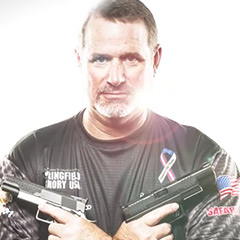
Rob LeathamLooking around to determine what action you need to take is radically different for competitive and defensive shooters. In this video, Team Springfield’s Rob Leatham and PDN’s Rob Pincus break it down.
Assessing the Environment: Competition
As Rob Leatham explains, the competitive shooter assesses his environment in advance of when he shoots. It’s called a walk-through and it happens before each stage of a competitive shooting event. At this time, Rob can determine where he should position himself in order to take the best shots. Assessing the environment is a key component to getting the best shots in the least amount of time, in a world where fractions of an inch and fractions of a second determine the winner.
Assessing the Environment: Personal Defense
Due to the nature of a defensive incident, collecting and processing information about the environment cannot occur in advance, and it’s a matter of life and death. How many bad guys are there? Where are they located? Where is the nearest cover you can take? As Rob Pincus explains, the defensive shooter has to determine all these things and more after the fight has started, not before.
Rob focuses on safety and the visualization aspect of defensive training. He also explains how assessing the environment is difficult under stress -- you must really see things, not just look wildly in all directions. He offers advice for how your defensive training and practice can build up your assessment skills.
All right Rob, so what is all this scanning thing I see you guys in the tactical world? You know, in competition, we just shoot targets. You guys do all the scanning back and forth and wagging the gun around. What is all that? Yeah, a lot of times it's nothing good, right?
A lot of times it really is just, you know, people look like they're crossing the street, or even worse, Right. they're flagging that gun around and they don't have a target, and I don't even know what that is. So, what I'm interested in, is assessment. We don't even use scan really, we talk about assessment, Assessment. assessing the environment.
Now assessing the environment's incredibly important and I think you'll agree, relative to the shooting, when do you assess your stage of fire? After I'm done shooting. I mean, if you're talking about, am I looking at the targets at the instant I'm engaging targets? No, I'm talking about when do you decide how you're going to deal with your stage? In a competition?
Yeah. I get a dance. Exactly. They give me a five-minute walkthrough and I literally get to walk around and plan, my foot will be here and not here. Exact, so you're assessing the environment Right.
before your fight. Right. Wouldn't that be awesome, if we could do that? Well it is, in competition, it is. In competition, you can.
We've made some- So, we can't do that. So essentially, imagine, take all that detail, 'cause you're one of the best in the world at this, you are looking for where's that, and you're like, dropping like, "Oh, I'm gonna put my foot" I don't need to do that anymore. I can pre-program exactly where to put my feet. But, that's it, right? Like, you know, "I'm gonna put my foot there." Well, we don't know that.
Now, if that's an alligator, I don't wanna step on the alligator, but I don't know there's an alligator there until after I'm in an incident. Right. Right? Now I have to assess. So, what you're doing before, the detail and level of concentration and level of focus that you put into what you're gonna do before the fight, You're doing it after the fight starts.
We're doing after that. We're doing it once we're in the fight. Right. So that's what this is. So check this out.
So, the idea is, if this is the stage, right? Okay, you're gonna start here with your hands on the table and the buzzer is gonna go and you're gonna turn and you're gonna shoot this guy and then you're gonna shoot that target over there. If you were, so you're standing there, where are you gonna move to, if you need to shoot that target? You can't shoot through the barricade. If I shoot this guy?
Yeah. Well, I'm gonna look for him here. I'm either gonna shoot him there, Boom. or I'm gonna come over here to this position here. All right, but you gotta do it as fast as you can, so you're gonna- Oh, then I'm going to the short step.
So you're just gonna take that one step and take that shot. Yeah. Well, the problem is, I don't know that guy's there in the fight. So, when I'm standing here at the counter, I'm thinking about which gun I'm gonna buy, and some guy comes in to rob the gun shop, I don't even know he has a friend with him, right? Just behind that display rack, whatever that is.
Right. So when I realize, "Oh shit, I'm being attacked," I'm gonna come back, I'm gonna get my gun out, I'm gonna drive out. Now I have to look around, I have to assess. And this seems really slow and ridiculous to you, but what I'm training myself to do is break my focus on that guy, and realize that something else may be happening. And when I see that next threat, now I'm gonna drive after that threat, and then I'm gonna visualize that threat going down, and I'm gonna do exactly the same thing, I'm gonna look around, do I see anybody else?
No? Okay, well I'm gonna see if I have another magazine, now I'm gonna make sure I get that magazine in there. Now my gun's topped off in case someone else shows up. And now I'm gonna start, "Hey, you call the police. Hey everybody, back up.
Hey, you do all that." And now I have a context for what I've just done. And what I've just done is simulated the reaction, the response, the assessment, the collecting and processing of information, and then the shot. And it all requires make-believe. Okay so, and I get all that, and I buy all that, and I live in that make-believe world. All our matches are make-believe, that we just happen to get attacked by 32 people Right.
that are gonna wait in position where I look- You stay there, sir. where they were at 15 minutes ago when I checked them out. So I gotta ask one question, because I see you do it all the time. As soon as you're done with the target, at that point, I just never wanna put the gun down. Right, right.
So, you're always bringing the gun back down. Yeah, yeah. That's what you wanna see? Okay. Yeah, and because again, think about it, if I've just shot this guy, I don't know how many, how many people have concealed carry?
Probably millions of people have concealed carry permits. The police are gonna respond, Right. security, if I'm standing here with a gun doing this, and this is one of the problems with this scan, this wagging of the gun around, I look potentially like a bad guy. Right. If I pull that gun in, I look a lot less like a bad guy, and I'm much less likely under a panic moment to see the threat, swing over there and over swing, right?
Yeah. We always see that a lot. Yeah. So now I'm here, if I see a threat, I'm driving out and it allows me to get that good, Right. base-level kinesthetic alignment, because I'm never practicing this imaginary, I know there's a bad guy, let me swing over there and shoot him.
Right. There's no context for that, Right. so we don't practice the skills. Let's not count on it, let's come in here and say, "Oh, there's the bad guy, let me drive out and shoot him," as I would engage any other individual threat. But the hard part is the suspension of disbelief.
So, in order to train the suspension of disbelief. So, suspension of disbelief? You're gonna disbelieve that that target's there, you're gonna forget that you know it's there, Okay. and you're gonna pretend that you have to find him. And here's how we do that.
You've got to, maybe look at me and see what I'm doing. You've got to look at somebody else on the range and learn something unique about them. You've got to look at the camera guy and see whether he's got his left hand or his right hand free, right? Oh, that guy scratched his head. And that tells you, oh- That process you call?
Assessment, that is assessing the environment, Everything. learning something specific to that moment. You're trying to see everything that's going on right now. The hard part is you can't see everything at once. That's why when you see these guys wagging their head around, they're not really seeing anything.
See, I see that in a lot of the training elements. I'll have someone and they just, it's a wagging head, they'll shoot, bang, bang, bang, and every single time, as soon as they're done, they do this, this, this. Right, and you know they're not seeing anything. 'Cause I'm standing right there. So a lot of competition guys say, "Well, that's dumb, don't do that," except what we need to do is not do it dumbly, Right.
which is this. We need to really turn and focus. So watch this, you're gonna shoot this target on the command, from the table. And then I'm gonna say, I'm gonna have you look at me and you're gonna have to see how many fingers I'm holding up, Okay. and however many fingers I'm holding up.
Tell you what, let's do it this way, we'll make it even more complicated, 'cause you're a good shooter. I already know you're a good shooter. So I'm gonna either hold up my left hand or my right hand. If I hold up my right hand, you have to go to the right of the barricade. If I hold up my left hand, you have to go to the left of the barricade to shoot the second target.
And you think I can tell the difference between left and right when I'm shooting stuff? Well, now, this is the hard part. I couldn't tell what half of eight was. It's four. Yeah, yeah.
Stand by. All right, so I'm da da da da da da. Threat! Four! And keep that gun in close, don't wag that gun around 'cause you'll look like a bad guy again.
That is so hard for me, Rob. It's so hard, it's so hard. That's so hard for me. And then get that gun back in, 'cause you've conditioned yourself to that. Now, why did I hold up four fingers and scream out, "Four"?
Because you know I have a problem with four. 'Cause you have a four phobia. So, it didn't have anything to do with it, all you had to do was tell whether I was holding my right hand or my left hand up, and as soon as I held up four, what did you? You, and then you hesitated, Right. And then you came over and did it.
So you did it, but it took you a minute to process the information. Right, it did. And so knowing that that's happening, that caused you a hesitation, it caused you to have to really process what was going on before you executed, and that's what assessment's really all about.
Share tips, start a discussion or ask other students a question. If you have a question for an expert, please click here.
Already a member?
No Responses to “Worlds Collide: Assessing the Environment”